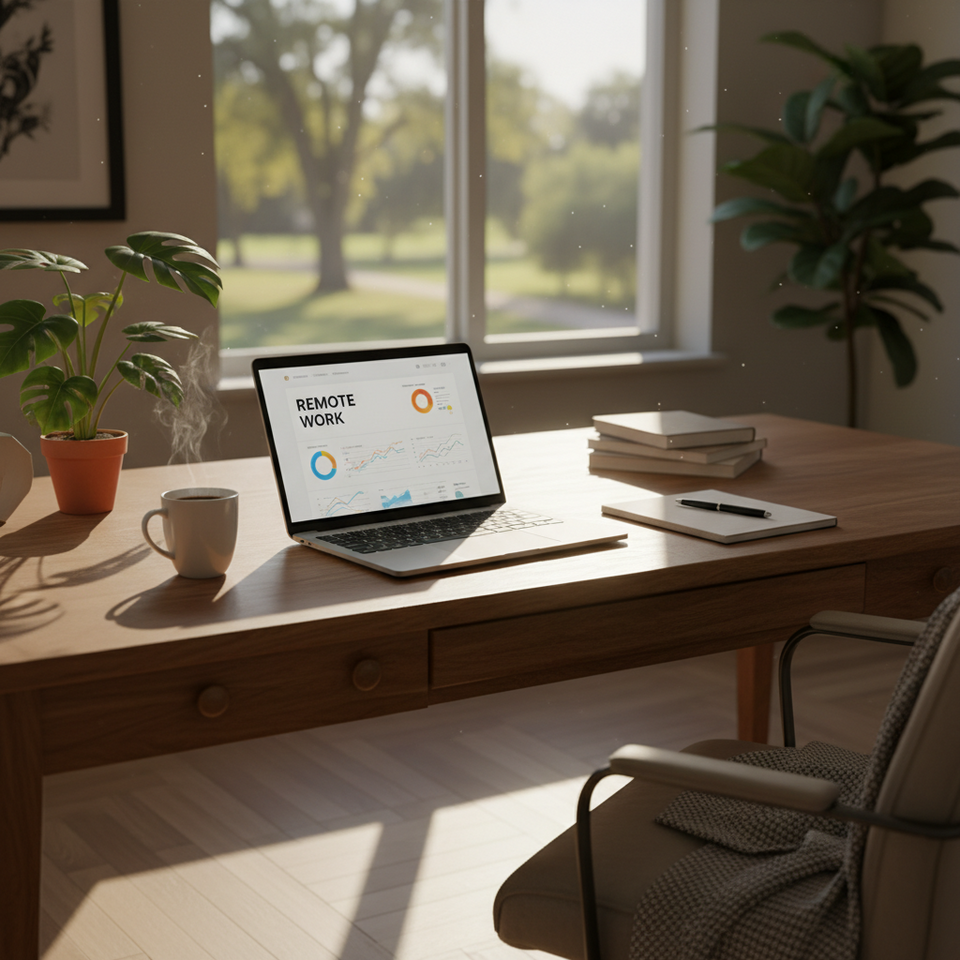

I still remember the Sunday Scaries hitting me like a freight train every week around 4:00 PM. The dread of the alarm clock, the hour-long commute in bumper-to-bumper traffic, and the fluorescent lights that seemed to drain my energy by noon. I used to think that was just “how life worked.” If you wanted a paycheck, you had to be in a chair under a boss’s nose.
But let me be honest: the world has changed, and so have I. Transitioning to a remote career wasn’t just a logistical swap for me; it was the single biggest catalyst for improving my mental health and moving toward financial independence. If you’re reading this, you’re likely feeling that same itch I felt—the desire for autonomy, location flexibility, and a work life that fits around your actual life, not the other way around.
Whether you want to negotiate with your current employer or pivot to a completely new career, this guide covers how to transition to remote work effectively. In this post, I’ll share the mistakes I made (so you don’t have to), the gear you actually need, and how to maintain your sanity when your office is also your living room.
1. The “Why” Behind the Move (It’s More Than Just PJ Bottoms)
Before we dive into the logistics, we need to talk about mindset. When I first started working remotely, I thought it was just about avoiding traffic. I quickly realized it was actually a cornerstone of a broader lifestyle strategy.
In the context of ZenWorkLife, remote work is a vehicle for financial freedom. Think about it: no commuting costs, fewer expensive lunches out, and no need for a high-end corporate wardrobe. Understanding financial freedom basics often starts with reducing overhead, and remote work does exactly that.
However, it requires a shift in how you view productivity. In an office, you get “points” for looking busy. At home, you are judged strictly on output. You have to be ready to trade presence for performance.
💡 Pro Tip: Calculate your “Commute Cost.” Add up gas, wear and tear, and your hourly wage multiplied by hours spent driving. Seeing that number (usually thousands of dollars a year) is great motivation to make the switch.
2. Assessing Your Readiness: Are You Built for This?
I’m going to be real with you—remote work isn’t for everyone. When I first tried this, I made the mistake of thinking I was an introvert who would love the solitude. Two weeks in, I was talking to my houseplants.
To successfully learn how to transition to remote work, you need to honestly assess a few soft skills:
- Self-Discipline: Can you work when Netflix is ten feet away?
- Communication: Can you express complex ideas clearly over Slack or email without tone getting lost?
- Tech-Savviness: Can you troubleshoot your own WiFi router when it crashes during a Zoom call?
According to the State of Remote Work report by Buffer, the biggest struggle for remote workers isn’t productivity—it’s unplugging after work and loneliness. If you crave constant social validation, you’ll need to build a robust social life outside of work before you transition.
3. Two Paths: Negotiating vs. Job Hunting
Generally, there are two ways to do this. You either convince your current boss, or you find a new one.
Path A: The Pivot (Negotiating with Your Current Employer)
If you love your job but hate the office, don’t just ask to “work from home.” Propose a trial run. Here is the script that worked for me:
“I’ve been tracking my productivity, and I’ve noticed I get 30% more deep work done on days when I have fewer interruptions. I’d like to propose a 30-day trial of working remotely on Tuesdays and Thursdays to see if we can boost that output permanently.”
Notice I focused on their benefit (productivity), not my desire to sleep in.
Path B: The Jump (Finding a Remote-First Role)
If you’re looking for a new role in 2025, you have to look in the right places. Standard job boards are okay, but niche boards are better. Sites like FlexJobs, We Work Remotely, and RemoteOK vet listings to avoid scams.
⚠️ Watch Out: Beware of “MLM” schemes or data-entry scams posing as remote jobs. If they ask you to pay for training or equipment upfront, run the other way.
4. The Setup: Designing a Zen Workspace
I learned this the hard way: working from the couch is a one-way ticket to back pain and nap time. To truly embrace the wellness and work-life balance we preach here, you need a dedicated zone.
You don’t need a massive home office, but you do need ergonomics. Here is my non-negotiable list:
- A Chair That Supports You: Don’t skimp here. Your spine will thank you.
- Monitor Height: Your screen should be at eye level. Laptop hunch is a real killer.
- Lighting: Natural light is best for mood. For calls, put a light behind your camera, not behind your head (unless you want to look like a witness protection interview).
A study from Stanford University showed that remote workers are 13% more productive, but that stat assumes they have a quiet environment. If you’re working from the kitchen table while your partner makes smoothies, that productivity tanks.
5. Establishing Boundaries: The “Fake Commute”
Here’s the thing about working where you sleep: the lines get blurry. My first month remote, I found myself answering emails at 9:30 PM just because my laptop was open on the coffee table.
You need a “Fake Commute.” This is a mental trigger that signals the workday has started or ended. For me, it looks like this:
- Morning: I pour coffee, put on “real” clothes (jeans, not sweatpants), and do a 10-minute stretch.
- Evening: I close the laptop, put it in a drawer (physically hiding it helps), and immediately go for a walk outside.
This separation is crucial. Without it, you aren’t working from home; you’re living at work.
6. Financial Implications and Geo-Arbitrage
This is where things get exciting for your bank account. Once you untether your income from a specific location, you unlock the power of Geo-Arbitrage—earning in a strong currency or high-salary market while living in a lower-cost area.
Even if you don’t move to Bali, simply moving an hour away from the city center can save you 30% on housing costs. I used these savings to max out my investment accounts.
✨ Quick Win: Check if your company adjusts salaries based on location. Many tech companies in 2025 have moved to location-agnostic pay, but some still adjust. Know this before you move to a cheaper state!
For more on managing your new surplus of cash, check out our guide on smart budgeting strategies for freelancers.
7. Common Mistakes to Avoid in 2025
I want to save you some headaches. Here are the pitfalls I fell into:
- Over-communicating poorly: Sending 10 Slack messages when one email would do. Learn asynchronous communication.
- The Isolation Trap: I went three days once without speaking to a human face-to-face. Now, I make it a point to work from a coffee shop or co-working space once a week.
- Ignoring Health: The fridge is right there. I gained the “Remote 15” (like the Freshman 15) because I grazed all day. Meal prep is just as important at home as it is for the office.
According to the American Psychological Association, social isolation increases the risk of premature death significantly. Don’t let your remote dream become a lonely nightmare. Schedule lunch dates, join a gym, or find a local meetup.
Conclusion
Transitioning to remote work isn’t just about changing where you sit; it’s about changing how you live. It offers the incredible opportunity to design a life that aligns with your values, whether that’s spending more time with your kids, traveling the world, or simply saving money for early retirement.
It takes discipline, better communication skills, and a conscious effort to separate work from rest. But I can tell you from experience—the freedom to control your own environment is worth every bit of the effort.
Start small. Fix your workspace today. Have that conversation with your boss tomorrow. You might be surprised at how ready the world is to accommodate you.
Ready to take control of your career freedom? Subscribe to the ZenWorkLife newsletter for weekly tips on remote work, wellness, and building wealth.
Frequently Asked Questions
Q: Can I transition to remote work with no experience?
A: Yes, but you need to highlight transferable skills. Focus on digital literacy, communication, and self-management. Look for entry-level roles in customer support, virtual assistance, or data entry, which are often remote-friendly and require less specialized experience than coding or design.
Q: How do I handle taxes if I work remotely from a different state?
A: This can be tricky. generally, you pay taxes where you are physically working. However, some states have reciprocity agreements. It is vital to consult with a CPA. Don’t hide your location from your HR department, as this can cause legal issues for the company.
Q: What if I feel unmotivated working alone?
A: Use the Pomodoro technique (25 minutes work, 5 minutes break). Also, try “body doubling”—working alongside a friend on video chat (muted) or using services like Focusmate. Sometimes, just seeing someone else working is enough to keep you on track.


 By
By